Chris De Guzman Steps Onto the International Stage as JKA Philippines as Signature Brand Model
The young medalist represents a new generation shaped by Japanese tradition, Filipino resilience and a distinctly global ambition
 Tomas Kauer - Senior News Editor
PARIS, France - September 8, 2026 — At a time when young athletes are increasingly becoming cultural ambassadors beyond the field of competition, promising Filipino karateka Chris Zachary Torres De Guzman, publicly known as Chris De Guzman, is preparing to introduce his story to an international audience.
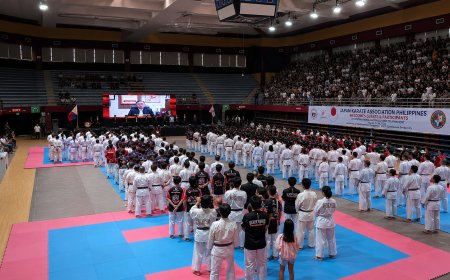
The young athlete from Lipa City, Batangas, has been selected as an official JKA Philippines Brand Model, placing him among the emerging personalities entrusted with representing the discipline, integrity and enduring traditions of Japan Karate Association karate.
A Grade 8 student and 1st kyu brown belt, De Guzman trains at JKA Lipa, an affiliate of JKA Philippines. Already a gold medallist in several tournaments, he now hopes to advance from domestic competition to the world stage, with the ambition of competing at the JKA World Cup in Japan.
“Every medal represents the hours of training, discipline, sacrifice and determination that people do not always see,” De Guzman said.
A Filipino Journey Rooted in Family
De Guzman began practicing karate at the age of nine after being introduced to the martial art by his mother, who had also trained in karate during her youth.
Her encouragement transformed an initial childhood experience into a serious personal commitment.
“I wanted to become physically stronger, develop discipline and eventually compete in tournaments through honest effort, hard work and integrity,” he recalled.
His journey reflects the strong role of family in Filipino culture. De Guzman considers his parents the most influential people in his life and credits their guidance and sacrifices for helping him balance academics, training and competition.
“I most want to make my parents proud,” he said. “Their belief in me motivates me to train harder and become a better karate practitioner and person.”
Japanese Discipline, Filipino Resilience
Karate has long travelled beyond Japan’s borders, finding new expression in communities throughout Europe, Asia and the rest of the world. De Guzman’s story demonstrates how its traditional principles can connect cultures while retaining their original emphasis on discipline, respect and character.
Under the guidance of Sensei Kim Masayuki Torres, De Guzman has learned that progress is rarely immediate. Some of his most meaningful experiences occurred during demanding training sessions when exhaustion tested his willingness to continue.
“Improvement often begins exactly when you feel like stopping,” he said.
The young karateka believes traditional Japanese discipline is complemented by qualities often associated with the Filipino spirit: resilience, determination, respect for others and loyalty to family.
For De Guzman, representing the Philippines through Japanese karate means honouring the origins and traditions of the martial art while demonstrating the commitment and strength of Filipino athletes.
“I would be proud to represent the Philippines with humility and respect,” he said.
Choosing Stronger Opponents
De Guzman is particularly drawn to kumite, the sparring discipline of karate. Instead of avoiding older or more experienced competitors, he sees difficult opponents as opportunities for growth.
“Competing against stronger karate practitioners challenges me to study their techniques, recognise my weaknesses and improve,” he explained.
His favourite technique is the spinning hook kick, a movement demanding speed, precision, timing, confidence and control. He considers it a reflection of his personality: determined, adventurous and willing to practise repeatedly until he achieves the result he wants.
Defeat, he said, is also an essential teacher.
“Losing does not mean that the journey is over,” he said. “It shows me what I need to improve and motivates me to return stronger and better prepared.”
A Role Beyond Competition
When De Guzman first learned that he had been selected as a JKA Philippines Brand Ambassador, his initial reaction was surprise.
“When I understood what the role meant, I felt incredibly happy, grateful and honoured,” he said.
He also recognised that the appointment carries responsibilities extending well beyond competition and promotional appearances.
As a public representative, De Guzman understands that his behaviour may influence how people view JKA Philippines and traditional karate. He intends to demonstrate respect and proper etiquette inside the dojo while becoming a responsible example for young people outside it.
“When I wear the JKA emblem, I represent JKA Philippines and the values of discipline, respect, humility and dedication,” he said.
Karate as an Answer to Bullying
Across Europe and other parts of the world, schools, families and sporting organisations continue to explore ways of building confidence and encouraging responsible behaviour among young people.
De Guzman believes properly taught karate can contribute to that goal.
Rather than encouraging aggression, traditional karate teaches practitioners to control their strength. Students learn that martial-arts skills should never be used to intimidate, bully or needlessly harm another person.
“Karate is not simply about fighting,” De Guzman said. “It is about discipline, respect, self-control and becoming a better version of yourself.”
He defines true strength not as physical dominance, but as the ability to control oneself, face personal fears and continue through adversity.
Inspiring Young People Across Borders
As a Brand Ambassador, De Guzman particularly wants to encourage young people who believe they are too shy, weak or inexperienced to enter a dojo.
“Everyone begins somewhere,” he said. “You do not need to be strong, confident or experienced on your first day. You only need the courage to begin and the willingness to learn, practise and improve.”
His message extends beyond karate. It speaks to young people facing pressure at school, fear of failure or uncertainty about their abilities.
For De Guzman, medals are valuable, but they are not the final measure of achievement.
“A medal is meaningful, but character stays with you throughout your life,” he said. “It influences how you treat people, respond to difficulties and use your success.”

From Lipa City to a Global Future
De Guzman’s immediate ambition is to continue developing as an athlete and eventually compete at the JKA World Cup in Japan.
His appointment introduces an emerging Filipino athlete whose personal story connects three cultures: the traditions of Japanese karate, the resilience and family values of the Philippines, and the international sporting community that unites practitioners across Europe and the world.
From a dojo in Lipa City, he now looks toward a future without borders—a future in which discipline may carry him from local competition to the international arena.
His personal motto captures the spirit of that journey:
For Chris De Guzman, it is more than a motivational phrase. It is the principle behind every lesson, every competition and every step toward representing the Philippines on the world stage.